 Add to Chrome
 Add to Firefox
 Add to Edge
AgentDoG 1.5: A Lightweight and Scalable Alignment Framework for AI Agent Safety and Security
May 28, 2026
Modern open-world agents such as OpenClaw exhibit powerful cross-environment execution capabilities yet introduce broad new safety risk sources. Meanwhile, advanced frontier AI models drastically lower attack barriers, rendering current agent alignment frameworks inadequate for real-world deployment. To tackle these emerging threats, we propose a lightweight and scalable agent safety alignment framework. Specifically, we update the agent safety taxonomy to accommodate emergent risks from Codex and OpenClaw execution scenarios. We further build a taxonomy-guided data engine with influence-function purification to train lightweight AgentDoG 1.5 variants (0.8B, 2B, 4B, and 8B parameters) using only around 1k samples, achieving comparable performance with leading closed-source models (e.g., GPT-5.4). Based on AgentDoG 1.5, we construct a highly efficient agentic safety SFT and RL training environment, which reduces deployment overhead in Docker-level environments by two orders of magnitude. Finally, we deploy AgentDoG 1.5 as a training-free online guardrail for real-time safety moderation. Extensive experimental results indicate that AgentDoG 1.5 achieves state-of-the-art performance in diverse and complex interactive agentic scenarios. All models and datasets are openly released.

Understanding Generalization through Decision Pattern Shift
May 13, 2026Understanding why deep neural networks (DNNs) fail to generalize to unseen samples remains a long-standing challenge. Existing studies mainly examine changes in externally observable factors such as data, representations, or outputs, yet offer limited insight into how a model's internal decision mechanism evolves from training to test. To address this gap, we introduce Decision Pattern Shift (DPS), a new perspective that defines generalization through the stability of internal decision patterns and quantifies failure as their deviation from those learned during training. Specifically, we represent each sample's decision pattern as a GradCAM-based channel-contribution vector, which captures how feature channels collectively support a prediction, and we propose the DPS metric to measure its discrepancy from the class-average pattern. Empirical analyses across multiple datasets and architectures show that, (i) decision patterns form a highly structured, class-consistent space with strong intra-class cohesion and low inter-class confusion, enabling direct analysis of a model's decision logic; (ii) the DPS magnitude correlates linearly with the generalization gap (nearly all Pearson r > 0.8), revealing generalization as a systematic drift in the model's internal decision mechanism; (iii) the DPS spectrum organizes diverse generalization degradation scenarios (covering ideal generalization, in-distribution degradation, domain shift, out-of-distribution, and shortcut learning) into a continuous trajectory, providing a unified explanation of their failure modes. These findings open up new possibilities for early generalization-risk detection, failure-mode diagnosis, and channel-level defect localization.
Rethinking Generalization in Reasoning SFT: A Conditional Analysis on Optimization, Data, and Model Capability
Apr 08, 2026A prevailing narrative in LLM post-training holds that supervised finetuning (SFT) memorizes while reinforcement learning (RL) generalizes. We revisit this claim for reasoning SFT with long chain-of-thought (CoT) supervision and find that cross-domain generalization is not absent but conditional, jointly shaped by optimization dynamics, training data, and base-model capability. Some reported failures are under-optimization artifacts: cross-domain performance first degrades before recovering and improving with extended training (a dip-and-recovery pattern), so shorttraining checkpoints can underestimate generalization. Data quality and structure both matter: low-quality solutions broadly hurt generalization,while verified long-CoT traces yield consistent cross-domain gains. Model capability is essential: stronger models internalize transferable procedural patterns (e.g., backtracking) even from a toy arithmetic game, while weaker ones imitate surface verbosity. This generalization is asymmetric, however: reasoning improves while safety degrades, reframing the question from whether reasoning SFT generalizes to under what conditions and at what cost.
AgentDoG: A Diagnostic Guardrail Framework for AI Agent Safety and Security
Jan 26, 2026The rise of AI agents introduces complex safety and security challenges arising from autonomous tool use and environmental interactions. Current guardrail models lack agentic risk awareness and transparency in risk diagnosis. To introduce an agentic guardrail that covers complex and numerous risky behaviors, we first propose a unified three-dimensional taxonomy that orthogonally categorizes agentic risks by their source (where), failure mode (how), and consequence (what). Guided by this structured and hierarchical taxonomy, we introduce a new fine-grained agentic safety benchmark (ATBench) and a Diagnostic Guardrail framework for agent safety and security (AgentDoG). AgentDoG provides fine-grained and contextual monitoring across agent trajectories. More Crucially, AgentDoG can diagnose the root causes of unsafe actions and seemingly safe but unreasonable actions, offering provenance and transparency beyond binary labels to facilitate effective agent alignment. AgentDoG variants are available in three sizes (4B, 7B, and 8B parameters) across Qwen and Llama model families. Extensive experimental results demonstrate that AgentDoG achieves state-of-the-art performance in agentic safety moderation in diverse and complex interactive scenarios. All models and datasets are openly released.
The Interaction Bottleneck of Deep Neural Networks: Discovery, Proof, and Modulation
Dec 21, 2025Understanding what kinds of cooperative structures deep neural networks (DNNs) can represent remains a fundamental yet insufficiently understood problem. In this work, we treat interactions as the fundamental units of such structure and investigate a largely unexplored question: how DNNs encode interactions under different levels of contextual complexity, and how these microscopic interaction patterns shape macroscopic representation capacity. To quantify this complexity, we use multi-order interactions [57], where each order reflects the amount of contextual information required to evaluate the joint interaction utility of a variable pair. This formulation enables a stratified analysis of cooperative patterns learned by DNNs. Building on this formulation, we develop a comprehensive study of interaction structure in DNNs. (i) We empirically discover a universal interaction bottleneck: across architectures and tasks, DNNs easily learn low-order and high-order interactions but consistently under-represent mid-order ones. (ii) We theoretically explain this bottleneck by proving that mid-order interactions incur the highest contextual variability, yielding large gradient variance and making them intrinsically difficult to learn. (iii) We further modulate the bottleneck by introducing losses that steer models toward emphasizing interactions of selected orders. Finally, we connect microscopic interaction structures with macroscopic representational behavior: low-order-emphasized models exhibit stronger generalization and robustness, whereas high-order-emphasized models demonstrate greater structural modeling and fitting capability. Together, these results uncover an inherent representational bias in modern DNNs and establish interaction order as a powerful lens for interpreting and guiding deep representations.
Attribution Explanations for Deep Neural Networks: A Theoretical Perspective
Aug 11, 2025Attribution explanation is a typical approach for explaining deep neural networks (DNNs), inferring an importance or contribution score for each input variable to the final output. In recent years, numerous attribution methods have been developed to explain DNNs. However, a persistent concern remains unresolved, i.e., whether and which attribution methods faithfully reflect the actual contribution of input variables to the decision-making process. The faithfulness issue undermines the reliability and practical utility of attribution explanations. We argue that these concerns stem from three core challenges. First, difficulties arise in comparing attribution methods due to their unstructured heterogeneity, differences in heuristics, formulations, and implementations that lack a unified organization. Second, most methods lack solid theoretical underpinnings, with their rationales remaining absent, ambiguous, or unverified. Third, empirically evaluating faithfulness is challenging without ground truth. Recent theoretical advances provide a promising way to tackle these challenges, attracting increasing attention. We summarize these developments, with emphasis on three key directions: (i) Theoretical unification, which uncovers commonalities and differences among methods, enabling systematic comparisons; (ii) Theoretical rationale, clarifying the foundations of existing methods; (iii) Theoretical evaluation, rigorously proving whether methods satisfy faithfulness principles. Beyond a comprehensive review, we provide insights into how these studies help deepen theoretical understanding, inform method selection, and inspire new attribution methods. We conclude with a discussion of promising open problems for further work.
Towards the Three-Phase Dynamics of Generalization Power of a DNN
May 11, 2025This paper proposes a new perspective for analyzing the generalization power of deep neural networks (DNNs), i.e., directly disentangling and analyzing the dynamics of generalizable and non-generalizable interaction encoded by a DNN through the training process. Specifically, this work builds upon the recent theoretical achievement in explainble AI, which proves that the detailed inference logic of DNNs can be can be strictly rewritten as a small number of AND-OR interaction patterns. Based on this, we propose an efficient method to quantify the generalization power of each interaction, and we discover a distinct three-phase dynamics of the generalization power of interactions during training. In particular, the early phase of training typically removes noisy and non-generalizable interactions and learns simple and generalizable ones. The second and the third phases tend to capture increasingly complex interactions that are harder to generalize. Experimental results verify that the learning of non-generalizable interactions is the the direct cause for the gap between the training and testing losses.
Towards the Resistance of Neural Network Watermarking to Fine-tuning
May 02, 2025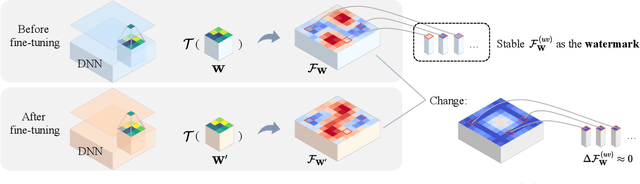
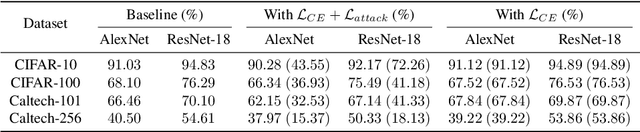
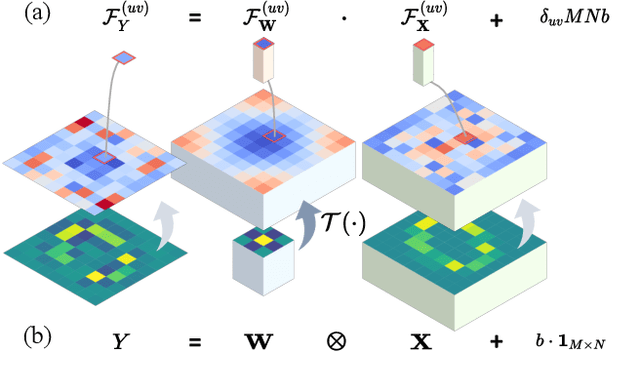

This paper proves a new watermarking method to embed the ownership information into a deep neural network (DNN), which is robust to fine-tuning. Specifically, we prove that when the input feature of a convolutional layer only contains low-frequency components, specific frequency components of the convolutional filter will not be changed by gradient descent during the fine-tuning process, where we propose a revised Fourier transform to extract frequency components from the convolutional filter. Additionally, we also prove that these frequency components are equivariant to weight scaling and weight permutations. In this way, we design a watermark module to encode the watermark information to specific frequency components in a convolutional filter. Preliminary experiments demonstrate the effectiveness of our method.
Randomness of Low-Layer Parameters Determines Confusing Samples in Terms of Interaction Representations of a DNN
Feb 12, 2025In this paper, we find that the complexity of interactions encoded by a deep neural network (DNN) can explain its generalization power. We also discover that the confusing samples of a DNN, which are represented by non-generalizable interactions, are determined by its low-layer parameters. In comparison, other factors, such as high-layer parameters and network architecture, have much less impact on the composition of confusing samples. Two DNNs with different low-layer parameters usually have fully different sets of confusing samples, even though they have similar performance. This finding extends the understanding of the lottery ticket hypothesis, and well explains distinctive representation power of different DNNs.
Alignment Between the Decision-Making Logic of LLMs and Human Cognition: A Case Study on Legal LLMs
Oct 06, 2024


This paper presents a method to evaluate the alignment between the decision-making logic of Large Language Models (LLMs) and human cognition in a case study on legal LLMs. Unlike traditional evaluations on language generation results, we propose to evaluate the correctness of the detailed decision-making logic of an LLM behind its seemingly correct outputs, which represents the core challenge for an LLM to earn human trust. To this end, we quantify the interactions encoded by the LLM as primitive decision-making logic, because recent theoretical achievements have proven several mathematical guarantees of the faithfulness of the interaction-based explanation. We design a set of metrics to evaluate the detailed decision-making logic of LLMs. Experiments show that even when the language generation results appear correct, a significant portion of the internal inference logic contains notable issues.